Language engineering
BiharLang
Custom programming language
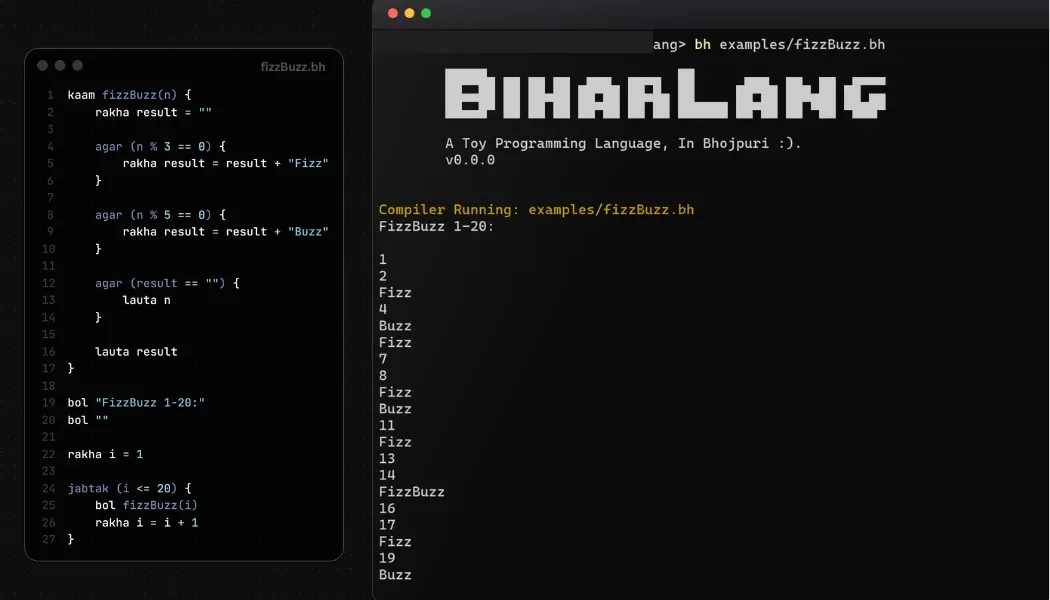
BiharLang is a dynamically typed language I wrote in Go with Bhojpuri keywords.
Role Independent developer
Tools and technologies
- Go
- Lexer
- Pratt Parser
- AST
- Tree-Walking Interpreter
- REPL
About BiharLang
BiharLang is a toy programming language I wrote from scratch in Go. It’s dynamically typed and interpreted, with keywords drawn from Bhojpuri. I built it to learn how programming languages work, and for fun. Thanks to my friends from Bihar who helped me pick the keywords.
It has a hand-written lexer, a Pratt parser, and a tree-walking evaluator. It runs .bh files and has an interactive REPL. Functions are first-class values and can be recursive or capture variables from an enclosing scope.
Project structure
Browse the Go packages
| Path | What it does |
|---|---|
cmd/bihari/ |
Runs script files and starts the REPL |
lexer/ |
Converts source text into tokens |
token/ |
Defines tokens and maps keywords to token types |
parser/ |
Assembles expressions and statements into an AST |
ast/ |
Defines the syntax tree nodes |
evaluator/ |
Evaluates the tree and manages lexical scope |
object/ |
Defines runtime values |
repl/ |
Reads and evaluates input interactively |
examples/ |
Contains sample .bh programs |
Installation and usage
These commands run from a checkout of BiharLang. Use the Go version specified in go.mod.
Build the CLI
# Windows
go build -o bh.exe ./cmd/bihari

# Linux or macOS
go build -o bh ./cmd/bihari
Add the binary’s directory to your PATH to use bh from any terminal.
Run a script or start the REPL
go run ./cmd/bihari examples/fizzBuzz.bh
go run ./cmd/bihari
With the compiled binary:
bh examples/fizzBuzz.bh
bh run examples/fizzBuzz.bh
bh repl
bh help
bh compile also runs a file, just like bh run. With no arguments, bh starts the REPL.
Run the tests
go test ./... -vThe lexer, parser, and evaluator each have their own unit tests.
Language reference
Keywords
| Keyword | Equivalent | Purpose |
|---|---|---|
rakha |
let / var |
Bind a variable |
bol |
print |
Print to the console |
agar |
if |
Start a conditional branch |
nata |
else |
Provide an alternative branch |
jabtak |
while |
Repeat while a condition holds |
kaam |
function |
Define a function |
lauta |
return |
Return a value |
sach |
true |
Boolean true |
jhoot |
false |
Boolean false |
kuchnahi |
null |
Null value |
Operators and delimiters
| Syntax | Purpose |
|---|---|
+ |
Integer addition or string concatenation |
-, *, / |
Subtraction, multiplication, and integer division |
==, != |
Equality and inequality |
<, >, <=, >= |
Comparisons |
= |
Bind a value, as in rakha x = 5 |
( ) |
Group expressions and enclose parameters or arguments |
{ } |
Enclose blocks |
, |
Separate arguments and parameters |
Runtime values
Integers, strings, booleans, null, and functions are represented as Go objects. The evaluator also uses objects to carry return values out of function bodies and to report errors. Every object implements the same interface:
type Object interface {
    Type() ObjectType
    Inspect() string
}
Examples
Open an example, edit the code, and hit Run.
Variables and printing
Show output
Ka ho Babu!
25
Conditionals
Show output
Ameer baFunctions and recursion
Show output
120Each recursive call binds its own n. The base case returns 1 and the pending calls multiply their results as they return.
While loop
Show output
1
2
3
4
5
Closures
Show output
10getX resolves x in its defining scope. A function keeps that environment even when it is returned and called later.
Star pattern
Show output
*
* *
* * *
* * * *
* * * * *
Architecture
- LexerSource code becomes a stream of tokens.
- Pratt parserTokens become an abstract syntax tree.
- Tree-walking evaluatorSyntax tree nodes produce runtime values.
Follow the same line through all three stages:
bol 2 + 3 * 41. Lexer · Read the tokens
The lexer reads characters and emits typed tokens. It recognizes identifiers, keywords, and literals, and reads both characters of operators like <= before emitting a token.
BOL("bol") INT("2") + INT("3") * INT("4") EOF2. Pratt parser · See the syntax tree
The parser uses operator precedence to build the tree. Multiplication binds more tightly than addition, so 3 * 4 becomes the right operand of +.
Print
└── +
    ├── 2
    └── *
        ├── 3
└── 4| Precedence, low to high | Operators |
|---|---|
| Equality | ==, != |
| Comparison | <, >, <=, >= |
| Sum | +, - |
| Product | *, / |
| Call | () |
3. Evaluator · See the result
The evaluator walks the tree. It computes 3 * 4, adds 2, then the print statement writes 14. When it evaluates a function call, it creates a new environment that points to the scope where the function was defined. That’s how a function can read an outer variable.
Roadmap
Planned features
The roadmap lists user input, arrays, hash maps, logical operators, comments, break and continue, built-in functions, file I/O, string methods, and a Windows installer.
License and inspiration
BiharLang is licensed under the MIT License. Bhai Lang inspired me to make something fun and weird of my own. I also learned from reading The Super Tiny Compiler, a small compiler written in Go.